Photos of the Day
The Blue Ridge Center is full of beautiful and interesting sights. We'll be posting a "Photo of the Day" on our homepage and on our Facebook page as often as possible so you can keep tabs on what's happening onsite. In case you missed some of the featured photos, here's a selection of recent shots.
March 21, 2011 - Frogs and salamanders are us! Here's John DeMary with a salamander caught in Wortman Pond during the annual amphibian field trip for students from Loudoun Valley High.
March 18, 2011 - Photo of the day: Mike Hayslett describes the intricacies of amphibian reproduction to a group of students from Loudoun Valley High, who are visiting the Blue Ridge Center this week to learn about frogs and salamanders. In this picture, Mike is displaying a spermatophore on a leaf that was plucked from the bottom of a vernal pool. After the males leave the spermatophores in the water, the females come and select from them -- though how they choose, according to Mike, is part of the mystery of amphibian reproduction.
March 14, 2011 - Photo of the day: Here's Nicole Hamilton with some frog eggs that she found in a vernal pool here at the Blue Ridge Center. Nicole gave a great slide show about the 25 kinds of amphibians found in Loudoun County and then led a very interesting field excursion. Thanks to Nicole and the Loudoun Wildlife Conservancy for bringing such valuable learning opportunities to the Blue Ridge Center.
Feb. 18, 2011 - Phil Daley (left) talks about insect galls during a recent Loudoun Wildlife Conservancy-sponsored hike at the Blue Ridge Center, with Bruce Johnson looking on. Besides being an eager hike participant, Bruce is the President of the Audubon Society of Northern Virginia.
Feb. 10, 2011 - Here's a closeup of the bird's nest that we found during Phil Daley's guided winter hike. Cup-shaped nests can be built in a variety of places, but normally they are built in trees. Often the
simplest form is wedged into a 'Y'-shape division of a branch, but many birds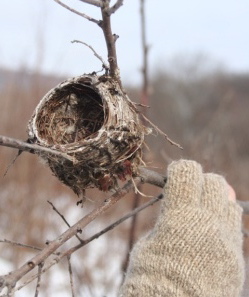 bind or cement them
directly to a bough. The smallest cup-shaped nests belong to the hummingbirds, which build perfectly-shaped, thimble-sized nests of moss and cobwebs. Different birds' nests take different lengths of time to build. Some are completed in a day, others take 2-3 weeks to complete.
Feb. 8, 2011 - We found skunk cabbage on the nature hike guided by Phil Daley last Sunday! Skunk cabbage is commonly found in wet areas, and it's one of the first plants to bloom in spring. The first part of the plant to appear is the spathe. The spathe is a brownish-purple, shell-like pod with green splotches. As the spathe gets bigger, it will reveal another part inside, called a spadix. The spadix is a little knob covered with small yellow flowers. By late spring, the skunk cabbage will send up a tightly rolled leaf. When the leaf unfurls, it may be one to two feet long and a foot wide. The leaves smell bad when crushed, so they attract flies -- but are possibly poisonous to mammals.
Feb. 4, 2011 - We always thought that possums come out only at night, but this one has recently been brazenly wandering the meadows in the middle of the day.
Feb. 2, 2011 - A stone chimney standing alone in the woods is a reminder of times gone by and people who used to live here.
Jan. 26, 2011 - Ice makes an interesting cap on last summer's Queen Anne's Lace flowers.
Jan. 21, 2011 - Here is our historic stone springhouse, frosted with a layer of snow.
Jan. 18, 2011 - In between recent snow storms, Mtn View Farm's Shawna DeWitt took her kids and her dog  for a picnic along Piney Run.
Jan. 11, 2011 - If you don't want to wade across Sweet Run, you can cross the creek on this unusual log bridge.
Jan. 6, 2011 -This interesting shelf mushroom, found on a rotten log along one of our hiking trails, looks like a Polyporus badius.