|
Historical & Cultural Stewardship
A SUMMARY OF RECENT HISTORY ON THE LAND
The Loudoun Valley of Virginia, and our stretch of it known as "Between the Hills," has witnessed roughly 10,000 years of human interaction with the landscape. Native Americans, in small numbers, came first, followed by a trickle and then a wave of white settlers in the 1700s and 1800s.
We have not yet conducted an intensive search for evidence of Native American presence on our land. However, the historical record from the colonial period onward is deep and varied. According to Millsaps College professor and archeologist Michael Galaty, "The archaeological and historical picture of the Foundation property that has begun to emerge appears to indicate periods of disuse, punctuated by episodes of intense occupation, further accompanied by significant investments in the built environment."
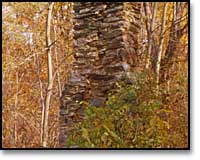
The most visible historical evidence includes the remains of many structures, varying from sturdy stone houses to remnants of old barns, and chicken coops and sheds. These buildings give testimony to the presence of a once thriving agricultural community. Cleared land, former dams, a network of woods roads, and fields only recently reclaimed by forest, add detail to the farming record.
Loudoun Valley in the 19th century also was an active north-south transportation route, and the Civil War prompted repeated movements along its length by both armies. These soldiers left their mark on the landscape, though their fleeting impacts are far more difficult to see and read — souvenir scavengers cleared the surrounding area long ago.
In the 20th century, the agrarian lifestyle practiced for more than 200 years fell into decline. Economic downturns, excessive commercial logging, and the blight of the American chestnut (caused by an accidentally introduced Asian fungus) had an effect on the people of the valley. The land eventually passed into the hands of owners who sometimes vacationed here, and who contemplated its eventual development as home sites.
"The Robert and Dee Leggett Foundation is the latest in a string of investors who have occupied and controlled large portions of the Loudoun Valley at various times since its initial settlement by Europeans more than 300 years ago," notes Galaty. "Whereas, until recently, those in control of the land have typically sought to exploit its industrial potential, the Foundation seeks to preserve it."
 return to top
Our Farm |
Our Land |
Blue Ridge Press
News from the Ridge |
Contact Us |
Site Map |
Home
© Copyright 2001, Blue Ridge Center for Environmental Stewardship.
All rights reserved.
|